
If you searched Plantiff or plaintiff, you’re almost certainly looking for the legal term plaintiff. Plaintiff is the correct spelling. Plantiff is a common misspelling of the word. In a civil lawsuit, the plaintiff is the person, business, or other party that initiates the case and seeks a legal remedy from the court.
Direct answer: A plaintiff is the party that brings a civil lawsuit against another party, called the defendant. The plaintiff usually files a complaint that states the facts and legal claims and asks the court for relief. That relief may include money damages, an injunction, or another court order.
| Key point | What it means |
|---|---|
| Correct spelling | Plaintiff |
| Common misspelling | Plantiff |
| Main role | Starts or brings a civil lawsuit |
| Opposing party | Defendant |
| Starting document | Usually a complaint |
| Possible remedy | Damages, injunction, or declaratory relief |
| Main proof responsibility | Establish the claims brought in the case |
| Criminal-case equivalent | The government prosecutes the accused |
Is Plantiff the Correct Spelling?
No. Plaintiff is the standard legal spelling used by courts, legal dictionaries, and legal-reference sources. Merriam-Webster defines a plaintiff as a person or party that brings a legal action. Cornell Law School’s Legal Information Institute uses the same spelling and describes the plaintiff as the party that initiates a civil lawsuit.
The spelling can be confusing because the word may not sound exactly as readers expect based on its written form. If you’re drafting a court document, a legal article, an email to a lawyer, or a school assignment, use “plaintiff”.
A simple memory aid is to connect plaintiff with complaint. The plaintiff is commonly the party who files the complaint.
What Does a Plaintiff Mean in Law?
A plaintiff is a person or legal entity that seeks relief from a court through a civil action. A plaintiff can be an individual, a company, a nonprofit organization, or another entity with the legal capacity to bring a claim.
In U.S. federal civil litigation, Federal Rule of Civil Procedure 3, as published by Cornell Law School’s Legal Information Institute, states that a civil action begins when a complaint is filed with the court. State procedures can differ, so the exact filing process depends on the court and jurisdiction.
A person also needs the legal right to bring a particular dispute before the court. This concept is called standing. In federal court, standing generally requires an injury, a connection between that injury and the challenged conduct, and the possibility that a favorable court decision can address the injury.
LawEzo’s nursing home abuse lawsuit guide is a practical example. It explains how a resident or an authorized representative may seek compensation for abuse or neglect.
Plaintiff vs. Defendant: What’s the Difference?
The distinction is straightforward at the outset of a typical civil lawsuit: the plaintiff brings the claim, while the defendant responds. Cornell’s legal dictionary defines a civil defendant as the person or entity being sued by the plaintiff.
| Plaintiff | Defendant |
|---|---|
| Brings the original civil claim | Is sued in the original civil claim |
| Files the complaint or petition | Responds to the allegations |
| Requests a legal remedy | Raises defenses and may dispute liability |
| Usually must establish the claims asserted | May have separate burdens for defenses or counterclaims |
A defendant’s formal answer can admit or deny allegations and may include affirmative defenses or counterclaims. That means litigation isn’t always as simple as one side making a claim and the other side defending against it.
Readers interested in employment-related disputes can also see LawEzo’s workers’ compensation lawyer guide for an example of how disputed workplace claims may move into hearings or court proceedings.
What Does a Plaintiff Have to Do in a Lawsuit?
The exact duties depend on the claim and the jurisdiction. In most civil cases, the plaintiff needs to:
- File the proper legal documents. The complaint sets out the dispute and the requested relief.
- Show the right to sue. The court may examine standing, jurisdiction, filing deadlines, and other procedural requirements.
- Support the claim with evidence. Documents, testimony, records, photographs, expert evidence, or other materials may become relevant.
- Meet the applicable burden of proof. The party bringing a claim generally carries the burden of establishing the elements required for that claim.
Cornell notes that plaintiffs seek remedies such as damages or injunctive relief and bear the burden of establishing the claims they bring. The exact elements depend on the cause of action.
Those elements can differ sharply between types of cases. A civil-rights claim may require different proof from a negligence or contract dispute. LawEzo has separate explanations covering civil-rights lawyers and civil-rights cases, as well as medical negligence lawyers.
Is There a Plaintiff in a Criminal Case?
The terminology changes in criminal proceedings. A criminal defendant is the person accused of an offense, while the government prosecutes the case. The prosecution must prove the defendant’s guilt under the criminal burden of proof.
That is different from a private civil lawsuit. A crime victim may be an important witness or injured party, but the victim does not normally occupy the same procedural role as a civil plaintiff in a criminal prosecution.
A related civil lawsuit can sometimes proceed alongside criminal proceedings. For example, conduct that leads to prosecution may also give an injured person grounds to seek civil compensation. The rules governing each proceeding remain separate.
Can Plaintiff and Defendant Roles Change?
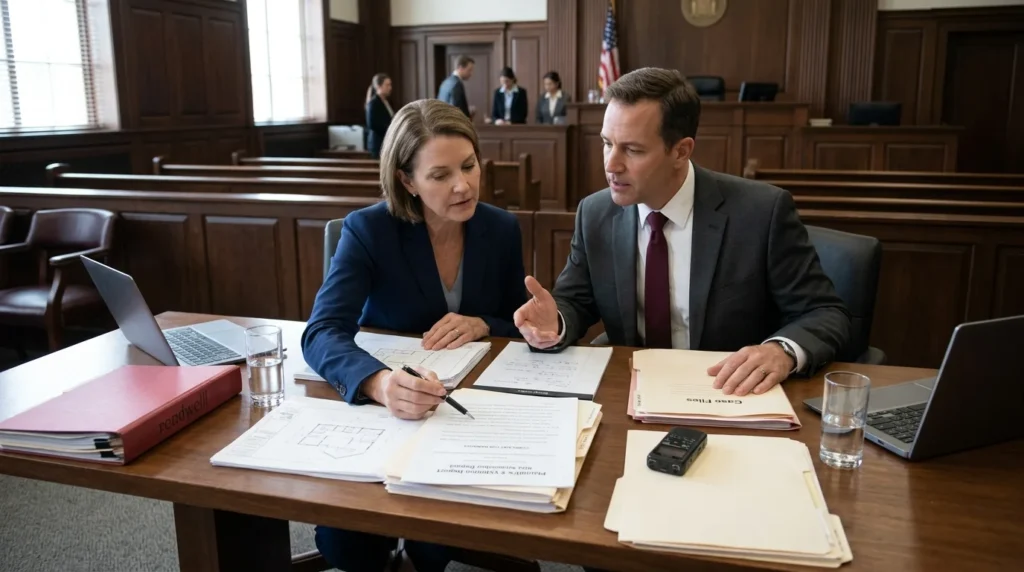
The roles can become more complicated once additional claims appear. A defendant may file a counterclaim against the original plaintiff. For that counterclaim, the defendant takes the offensive position and normally bears the burden associated with the new claim. The original plaintiff must then defend against it.
The labels also change on appeal. The party challenging a lower court decision becomes the appellant, while the opposing party is generally the appellee or respondent. Either the original plaintiff or the original defendant can become the appellant.
This is why identifying a party solely by whether it is the “plaintiff” or “defendant” can become misleading once a case moves beyond the original trial-stage dispute.
A Simple Example
Suppose Maya pays a contractor to repair her roof. The contractor takes payment but allegedly abandons the project after causing additional damage.
Maya decides to sue for her financial losses. She files the civil complaint, so Maya is the plaintiff. The contractor is the defendant.
Maya still doesn’t win merely because she filed first. She must establish the required elements of her legal claim using admissible evidence. The contractor can deny her allegations, raise defenses, or bring a counterclaim if there is a valid basis for doing so.
That example captures the key distinction: the labels identify the parties’ procedural positions, not who is automatically right.
Know Your Role Before Taking Legal Action
Understanding who the plaintiff is helps you read court papers, follow a lawsuit, and distinguish civil cases from criminal prosecutions. If you’re dealing with a real dispute, check the rules for your state and court before relying on general definitions.
Legal terminology explains the parties’ roles. It doesn’t determine whether a claim will succeed. A licensed attorney in the relevant jurisdiction can assess deadlines, evidence, standing, defenses, and the legal elements of a specific case.
Frequently Asked Questions
Yes. A plaintiff need not be an individual. A company or another legal entity may bring a civil lawsuit when it has a valid claim and meets the applicable procedural requirements.
A plaintiff generally bears the burden of proof for the claims it brings. Burdens can differ for particular issues. A defendant who brings a counterclaim, for example, bears the burden associated with that counterclaim.
The terms can overlap, but court terminology varies by jurisdiction and type of proceeding. Some legal systems or proceedings use claimant, petitioner, or another label instead of plaintiff.
The trial-court plaintiff doesn’t necessarily keep that label for appellate purposes. The party filing the appeal is generally called the appellant, and the other party becomes the appellee or respondent.
Plaintiff is commonly misspelled as “plantiff”; the term refers to the party that begins a civil lawsuit and seeks a legal remedy from the court. Standard legal sources spell the word plaintiff.