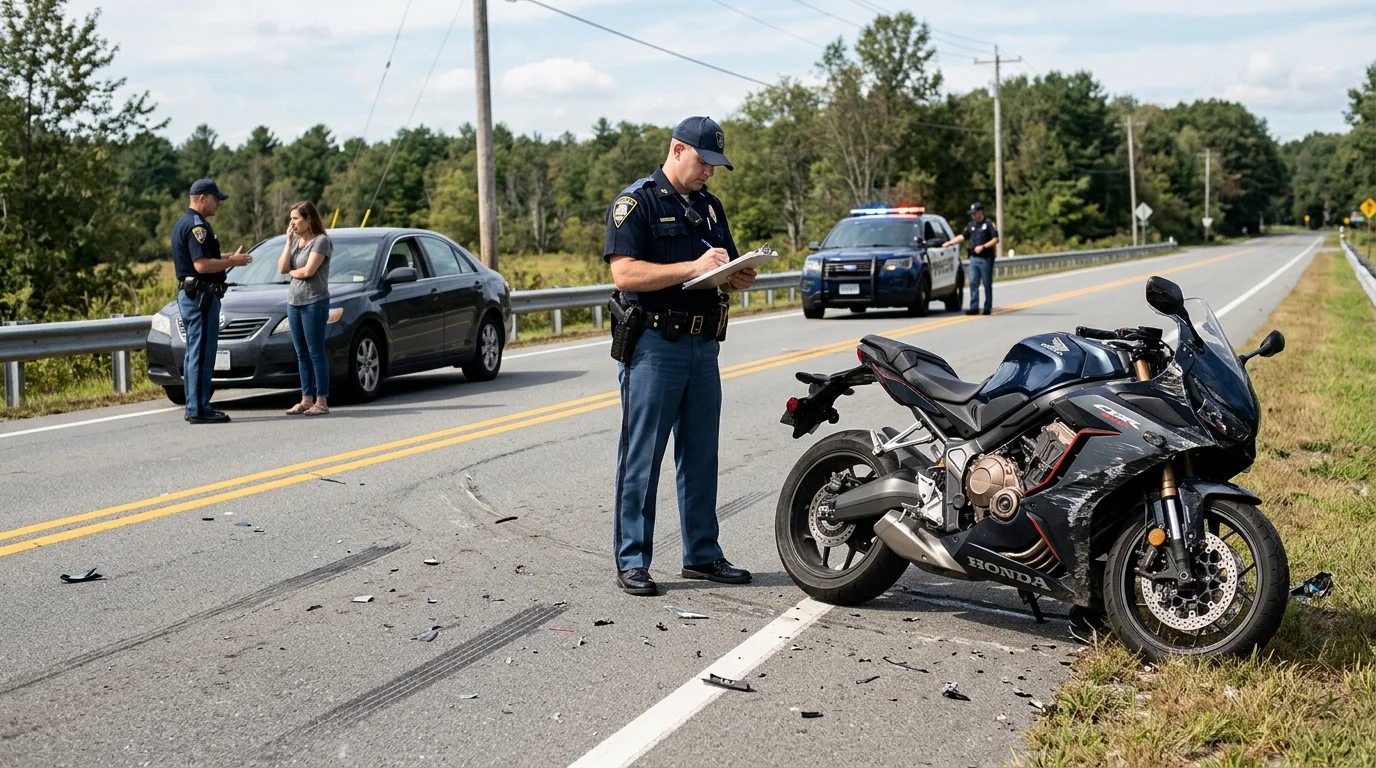
A serious crash can trigger more than insurance claims and traffic tickets. Criminal liability for motorcycle accident cases can arise when conduct crosses the line from negligence into criminal behavior. State law controls that line, so the exact charge and required proof vary across the United States.
Direct answer: A motorcycle crash does not automatically create criminal liability. Charges become more likely when evidence shows intoxication, reckless driving, leaving the scene, or conduct causing serious injury or death. Prosecutors must prove the required criminal elements under the law of the state where the crash occurred.
| Question | General U.S. answer |
|---|---|
| Does every motorcycle crash create criminal charges? | No. Ordinary negligence usually remains a civil or traffic matter. |
| What conduct creates the greatest criminal risk? | DUI, reckless driving, hit-and-run conduct, and dangerous behavior causing death or serious injury. |
| Can a fatal crash become a felony? | Yes. State vehicular homicide or manslaughter laws may apply. |
| Does fault in an insurance claim prove a crime? | No. Criminal prosecutors generally must meet a much higher burden of proof. |
| Can the motorcyclist face charges? | Yes. Riders and other drivers can face charges when their conduct satisfies state criminal law. |
| Who decides whether charges are filed? | Police investigate, while prosecutors generally decide which criminal charges to pursue. |
When Does Criminal Liability for Motorcycle Accident Cases Apply?
An accident alone usually does not establish a crime. Civil negligence may involve failing to use reasonable care under the circumstances. Criminal cases normally require additional facts showing a legally defined level of fault.
The distinction matters because criminal punishment serves a different purpose from compensation. An injured person may pursue damages even when nobody faces criminal prosecution. Lawezo’s accident injury guide explains how negligence, evidence, and damages work in civil claims.
State criminal statutes use terms such as recklessness, criminal negligence, vehicular manslaughter, or vehicular homicide. Those terms are not interchangeable across every jurisdiction. Cornell’s Legal Information Institute notes that vehicular homicide rules differ by jurisdiction and can involve illegal or negligent vehicle operation.
The Conduct Most Likely to Lead to Criminal Charges
Several facts can turn a traffic collision into a criminal investigation. Prosecutors examine the behavior before, during, and sometimes after the crash. They also review whether that behavior caused the injury or death at issue.
Common factors include the following.
- Riding or driving while impaired by alcohol or drugs
- Excessive speeding combined with other dangerous conduct
- Street racing or deliberate aggressive driving
- Running red lights while driving dangerously
- Driving with extreme disregard for other road users
- Leaving the scene without complying with state duties
- Causing death while committing a qualifying traffic crime
A single traffic mistake may not satisfy a criminal statute. Context usually determines whether behavior reaches the required level of recklessness. New York courts, for example, require more than ordinary negligence for reckless driving.
DUI or Drug-Impaired Riding After a Crash

Impaired riding creates significant criminal exposure even without a collision. A crash causing injuries or death can produce additional or enhanced charges. State statutes determine which offenses apply and how prosecutors must prove impairment.
NHTSA reports that motorcycle operators had the highest alcohol-impaired percentage among vehicle operators involved in fatal crashes during 2024. The agency also reports that 6,228 motorcyclists died in U.S. traffic crashes that year. Those figures show why impaired motorcycling remains a major enforcement concern.
The standard adult alcohol limit is generally 0.08% BAC across the United States. Utah uses a lower 0.05% limit for ordinary drivers. Drug impairment can also support DUI charges even when alcohol is not involved.
Anyone facing an impaired-driving prosecution should distinguish legal information from case-specific advice. Charges, license consequences, defenses, and sentencing rules vary widely by state. Lawezo’s DUI lawyer cost guide also explains how case complexity can affect defense expenses.
Reckless Driving and Criminal Negligence
Reckless driving generally requires more than a careless mistake. The prosecution may need facts showing conscious or extreme disregard for safety. Speed can matter, but speed alone does not define every reckless-driving case.
Courts may examine lane changes, traffic signals, visibility, road conditions, and prior conduct. Racing or repeatedly weaving through traffic can strengthen allegations of recklessness. Evidence from dash cameras, witnesses, vehicles, and crash reconstruction may become important.
Cornell describes reckless driving as a fact-intensive question in many jurisdictions. Its overview also notes that reckless driving is commonly treated as a misdemeanor. The exact definition and punishment still depend on state law.
Following too closely can also become more serious when combined with aggressive conduct. Ordinary tailgating often produces a traffic citation instead. Lawezo’s guide to tailgating laws explains how dangerous driving can cross into criminal territory.
What Happens When Someone Dies?
A fatal motorcycle crash can lead to vehicular homicide, vehicular manslaughter, or another homicide charge. The name and elements depend on the jurisdiction. Prosecutors must also connect the defendant’s prohibited conduct to the death.
Washington illustrates how much state law can matter. Its vehicular homicide law covers qualifying deaths caused by DUI, reckless driving, or disregard for others’ safety. The offense is classified as a felony under Washington law.
New York uses several separate homicide offenses for vehicle-related deaths. Recent state cases show charges involving vehicular manslaughter, aggravated vehicular homicide, and ordinary manslaughter. The required mental state and surrounding circumstances determine which statutes may apply.
Unintentional death does not automatically mean there is no criminal case. Some homicide statutes specifically cover deaths caused without an intent to kill. Lawezo’s involuntary manslaughter explanation provides broader context on unintended killings and criminal culpability.
Can Leaving the Scene Create Separate Liability?
Leaving a crash scene can create a separate offense from whatever caused the collision. State laws generally impose duties after crashes involving injury or death. Those duties can include stopping, providing information, and contacting emergency authorities.
A person may therefore face charges even when prosecutors cannot prove the original crash was criminal. The departure itself can become an independent focus of the case. Penalties usually become more serious when someone was badly injured or killed.
Post-crash conduct can also affect how investigators view the case. Attempts to conceal evidence can create additional legal problems. A 2025 New York appellate case involved manslaughter, leaving the scene, and evidence-tampering convictions after a fatal incident.
Criminal Liability and Civil Liability Are Different
Criminal and civil cases answer different questions. A criminal prosecution asks whether the government can prove a statutory offense. A civil claim generally asks whether someone owes compensation for legally recognized harm.
The burdens of proof are also different. Criminal guilt generally must be established beyond a reasonable doubt. Civil liability ordinarily uses a lower standard, although terminology and rules vary by jurisdiction.
That means one crash may produce both proceedings. A driver could face criminal prosecution while an injured person pursues compensation separately. A civil case may also proceed even when prosecutors decline to bring criminal charges.
What Evidence Can Prosecutors Use?
Traffic-crime investigations can involve physical, digital, medical, and witness evidence. No single type of proof decides every case. Investigators generally build a timeline and compare that evidence with the elements of possible offenses.
Evidence may include the following.
- Police crash reports
- Witness statements
- Roadside or surveillance video
- Dash-camera or helmet-camera footage
- Vehicle event data
- Cellphone records when legally obtained
- Blood or breath testing
- Drug toxicology results
- Skid marks and roadway evidence
- Vehicle damage patterns
- Crash reconstruction findings
- Statements made after the collision
Evidence also matters to injured people pursuing civil claims. Photos, medical records, reports, bills, and witness details can support compensation claims. Preserving those materials early can reduce factual disputes later.
Does the Same Rule Apply in Every State?
No nationwide criminal statute governs ordinary motorcycle crashes across all states. Each state defines its traffic crimes, homicide offenses, defenses, and sentencing rules. Even similarly named crimes can require different proof.
This difference makes broad penalty estimates unreliable. One state might treat particular conduct as reckless driving. Another could authorize a felony charge when the same conduct causes death.
Readers should therefore check the law where the collision occurred. Official state statutes and current court decisions are stronger sources than generic penalty charts. A locally licensed attorney can explain how those rules apply to specific facts.
What Should You Do After a Serious Crash?
Safety and medical needs come first after a collision. Contact emergency services when anyone may be injured. Follow state reporting requirements and avoid disturbing evidence unnecessarily.
Keep copies of available reports, photographs, medical records, and insurance communications. Do not delete relevant videos or messages. You should also avoid guessing about fault when speaking publicly about an unresolved investigation.
A person who may face charges should seek qualified criminal-defense advice promptly. An injured person may need separate advice about insurance or a civil claim. The same attorney may not be appropriate for every party involved.
Frequently Asked Questions
Can criminal liability for motorcycle accident cases arise without a death?
Yes, depending on the state and the conduct involved. DUI, reckless driving, assault-related offenses, or leaving an injury crash may support charges. A death is not required for every traffic-related crime.
Is causing a motorcycle crash automatically reckless driving?
No. Ordinary mistakes and negligent driving do not automatically satisfy a criminal recklessness standard. Prosecutors must prove the elements required by the applicable state statute.
Can a motorcyclist be charged after causing the crash?
Yes. Criminal traffic laws generally apply to motorcycle operators as well as other motorists. Charges depend on the rider’s conduct, the resulting harm, and state law.
Can the other driver face criminal charges for hitting a motorcyclist?
Yes, when the driver’s conduct satisfies a criminal statute. DUI, reckless behavior, hit-and-run conduct, or a qualifying fatal crash can create criminal exposure. Simple negligence may instead remain a civil or traffic matter.
Does a traffic ticket mean someone is criminally liable?
Not necessarily. Many moving violations are infractions rather than crimes. A prosecutor needs evidence supporting the elements of a criminal offense before obtaining a conviction.
Can there be both a criminal case and a personal injury lawsuit?
Yes. The government controls the criminal prosecution, while an injured party controls a civil damages claim. Different standards, procedures, and remedies apply to each case.
The Bottom Line
A motorcycle crash becomes a criminal matter because of the conduct involved, not merely because an accident occurred. DUI, recklessness, leaving the scene, serious injury, and death can change the legal stakes. The governing criminal statute always depends on the state.
Anyone involved in a serious collision should preserve evidence and identify the applicable state law quickly. Criminal defendants and injured parties may have different legal interests. Case-specific questions should go to an attorney licensed where the crash occurred.